
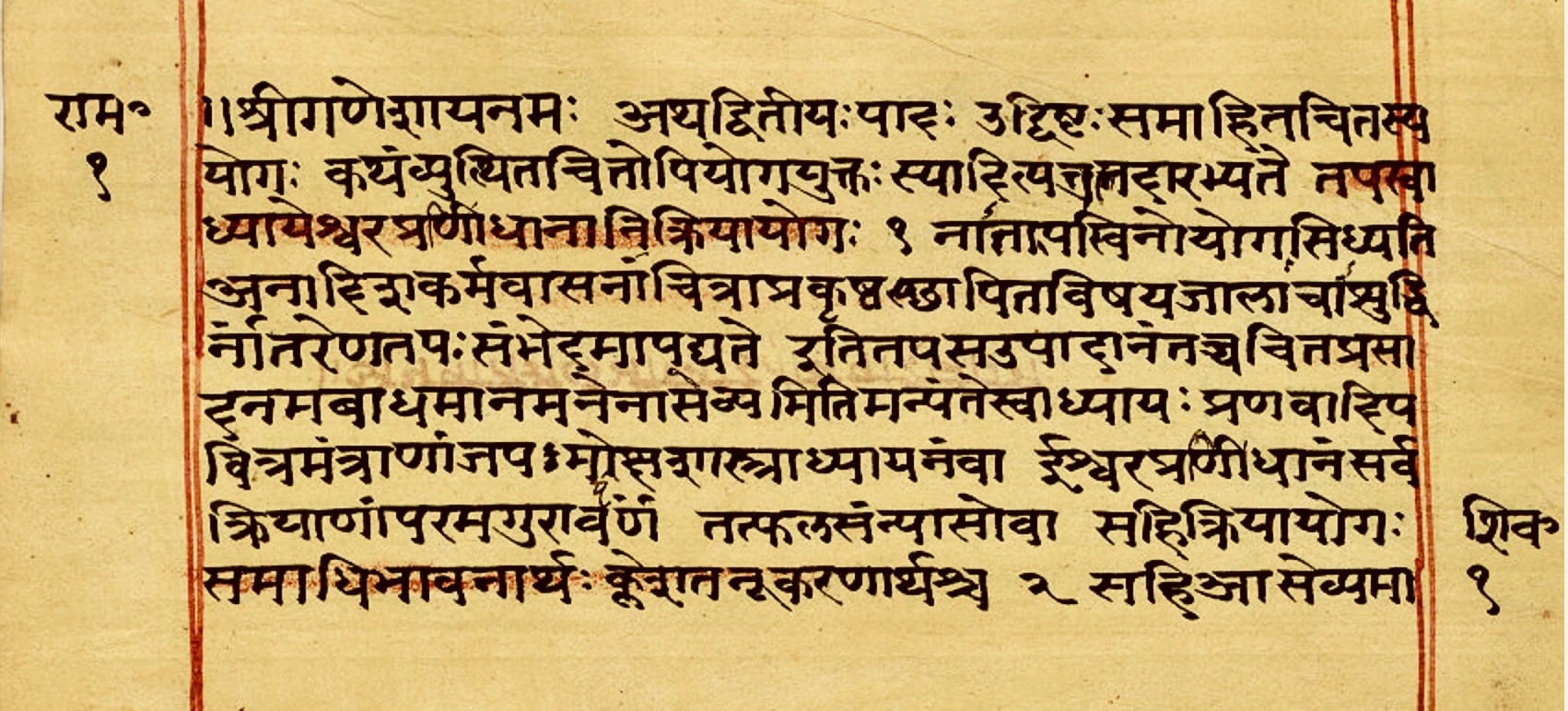
Yoga Sutra 1.9 introduces vikalpa: the strange but everyday mental activity of holding ideas that sound like knowledge but point to nothing real. Patanjali calls it the third of the five vrittis — the mental modifications that ripple across the mind and pull us away from the still witness within. In this guide you’ll learn what vikalpa really means, how it differs from valid knowledge (pramana) and error (viparyaya), why it matters for your practice, and how to spot it on the mat and off it.
The Sanskrit of Yoga Sutra 1.9
The verse, in transliteration, reads:
The next vritti in Patanjali’s sequence, nidra (Yoga Sutra 1.10), defines sleep as its own distinct movement of mind — worth reading alongside vikalpa for the full picture.
śabda-jñāna-anupātī vastu-śūnyo vikalpaḥ
— Yoga Sutra 1.9
A common English rendering is: “Vikalpa is conceptual knowledge that follows verbal expression but has no object in reality.” The verse describes a vritti made of pure language — an idea built from words that does not correspond to any real thing the mind has perceived or inferred.
Word-by-Word Breakdown
- śabda — sound, word, verbal expression.
- jñāna — knowing, cognition, information.
- anupātī — following along with, depending upon, sequentially related to.
- vastu — an actual thing, an object that exists.
- śūnya — empty of, devoid of, without.
- vikalpaḥ — imagination, conceptual construction, verbal delusion.
Put together: vikalpa is a cognition that tracks language (śabda-jñāna-anupātī) but is empty of an actual object (vastu-śūnya). It is the mind treating a phrase as if it pointed at something real, when in fact there is nothing there to point at.
Where Vikalpa Sits in the Five Vrittis
In sutra 1.6, Patanjali names the five vrittis: pramana (right knowledge), viparyaya (misperception), vikalpa (verbal construction), nidra (sleep) and smriti (memory). Each sutra from 1.7 onward defines them one at a time. Vikalpa is the third in the list, sandwiched between two related but distinct mental events:
- Pramana (1.7) — knowledge grounded in valid perception, inference, or testimony. The cognition matches an actual object.
- Viparyaya (1.8) — a false cognition: you see a rope and the mind reports “snake.” There is a real object, but the perception of it is wrong.
- Vikalpa (1.9) — a cognition built only from language. There is no real object to verify or misidentify; only words generating an impression of a thing.
To explore the surrounding sutras side by side, see our piece on Yoga Sutra 1.8: Viparyaya and the broader overview in The 5 Vrittis: Yoga Sutra 1.6 Explained.
Classic Examples of Vikalpa
Traditional commentators reach for examples like:
- “The horns of a rabbit.” The phrase is grammatical and intelligible; rabbits have no horns. The mind forms a picture anyway.
- “The son of a barren woman.” Logically impossible, yet language allows the construction.
- “Consciousness of consciousness.” A phrase that piles word on word. Vyasa’s commentary uses similar reflexive constructions to show that grammar can manufacture concepts that point nowhere.
What unites the examples is not falseness in the ordinary sense — vikalpa is not a lie or an honest mistake. It is a cognition produced by language itself, with no corresponding referent in experience. The mind takes the bait because the words obey the rules of syntax.
How Vikalpa Differs From Error and Imagination
It can be tempting to fold vikalpa into “imagination” or “fantasy.” Patanjali is more precise. The distinguishing features are:
- Vikalpa is born of words, not of senses. Viparyaya begins with a real sense-contact that is misread; vikalpa begins with a phrase that the mind treats as though it were a perception.
- Vikalpa can feel coherent. Because it follows the grammar of language, it does not produce the immediate “wait, that’s wrong” feeling that misperception eventually triggers when the rope is touched.
- Vikalpa is not always harmful. Mathematics, poetry, and law all rely on useful vikalpas — concepts like “infinity,” “justice,” or “the average person.” The work of yoga is to see these as vikalpa rather than confuse them with first-hand knowing.
Why Vikalpa Matters For Your Practice
The whole arc of the first chapter is set by sutra 1.2: yogas chitta-vritti-nirodhah — yoga is the stilling of the modifications of the mind. If you don’t know what counts as a vritti, you cannot soften it. Vikalpa is sneaky because it imitates real cognition. Three places it shows up in practice:
- On the mat. Internal narration during asana — “I’m bad at backbends,” “my hips are tight,” “this pose should look like X” — is often pure vikalpa. The words feel like data, but they are constructions, not direct perception of the body.
- In meditation. Beginners often chase mental images of “stillness” or “the witness.” These images are language-shaped concepts, not the experiences themselves. Recognising them as vikalpa allows the meditator to let them go.
- In identity. Phrases like “I am a beginner,” “I am an advanced yogi,” or “I am not flexible” function as vikalpa: language-driven self-descriptions that the mind treats as fixed objects.
Returning to Sutra 1.2 with vikalpa in mind makes the project of yoga concrete: not all thoughts are equal, and the verbal-construct kind needs special care.
Useful Vikalpa vs Binding Vikalpa
Vyasa’s commentary points out that some vikalpas, while empty of object, are functionally useful. A teacher saying “imagine the crown of your head lifting toward the ceiling” produces a helpful image even though no literal lifting is happening. The same applies to:
- Mantras and Sanskrit syllables, which use sound to evoke states.
- Visualisations of deities, light, or geometry in tantric and bhakti practice.
- Anatomical cues like “lengthen the spine” or “soften behind the eyes.”
These vikalpas shape attention in a desired direction. The trouble starts when the practitioner forgets the cue is a construct and begins defending it as literal anatomy, dogma, or identity. Useful vikalpa points beyond itself. Binding vikalpa pretends to be the thing.
Practical Tools For Working With Vikalpa
Patanjali offers the general remedies of abhyasa (steady practice) and vairagya (non-attachment) in sutras 1.12 onward. Applied to vikalpa specifically, three drills are useful:
1. Name The Vritti
During meditation, when a thought arises, briefly label it: perception, misperception, verbal construct, memory, or sleep. Spotting vikalpa as vikalpa robs it of its claim to be reality.
2. Question The Referent
When you catch yourself in a heavy thought — “I always lose focus,” “my back is weak” — ask: If I dropped every word, what direct experience would remain? The answer is usually a sensation, much smaller than the story.
3. Use Cue, Then Release Cue
Visualisations and verbal cues are powerful entry doors. Set the cue, feel the effect in the body or breath, then drop the words and rest in what remains. This is the practical answer to “useful vikalpa”: use it deliberately and don’t mistake it for the destination.
Frequently Asked Questions About Vikalpa
Is vikalpa the same as imagination?
Imagination is one expression of vikalpa, but the technical sense is narrower. Vikalpa is specifically a cognition that follows words and has no actual object — closer to “verbal construct” than the broader English word “imagination.”
Is vikalpa always bad?
No. Patanjali does not moralise the vrittis. Like all vrittis they can be klishta (afflicted, binding) or aklishta (non-afflicted, useful) — a distinction made explicit in Sutra 1.5. Verbal constructs that help refine attention are aklishta; those that bind identity are klishta.
How is vikalpa different from a metaphor?
A metaphor is a known device — speaker and listener both know the words point obliquely at something else. Vikalpa becomes a problem when the mind forgets it is dealing with a construction and begins treating it as direct perception.
Where does vikalpa show up in modern psychology?
The concept overlaps with what cognitive therapy calls “verbal rumination” or “cognitive fusion” — the experience of being entangled with thoughts as if they were facts. Yoga’s response is similar in spirit: bring awareness to the thought, see it as a vritti, and let attention return to direct experience.
What The Classical Commentators Say
The earliest surviving commentary on the Yoga Sutras, Vyasa’s Yoga Bhasya, treats vikalpa with unusual care. Vyasa notes that it is “neither right knowledge nor wrong knowledge” — a third category sitting between truth and error. He draws attention to phrases used in everyday speech that are perfectly intelligible yet refer to nothing: “the awareness of awareness,” “the soul of the soul,” “this is that.” Each is grammatical, each generates a mental image, and none corresponds to a discrete object you could point at.
Later commentators sharpen the analysis. Vachaspati Mishra, in the Tattva-vaisharadi, emphasises that vikalpa rides on linguistic conventions rather than perceptual contact. Vijnana Bhikshu, in the Yoga Varttika, links vikalpa to the imagination of yogis themselves — pointing out that even meditators can become attached to ideas of “stages,” “states,” and “attainments” that are entirely linguistic. The warning, gentle but firm, is that the spiritual life is not exempt from verbal delusion.
Modern translators render the term variously — “verbal delusion,” “conceptual fancy,” “imagination,” “abstract knowledge.” None is perfect on its own; together they triangulate the meaning. For a sense of how language and cognition appear elsewhere in the same chapter, the discussion of valid knowledge in Sutra 1.7 is a natural companion read, because it sets the criteria that vikalpa fails to meet.
Vikalpa And The Subtle Body
Tantric and hatha traditions adopt vikalpa as a working tool. The body in these systems is described through subtle anatomy — chakras, nadis, koshas — that the practitioner cannot directly perceive at first. Teachings present these as useful vikalpas: scaffolds that, when meditated on consistently, draw subtle experience into the field of awareness. The point is never to argue for or against their literal existence as objects; it is to use the construct, observe what arises, and then drop the scaffolding.
Working With Sutra 1.9 In Daily Life
The gift of Yoga Sutra 1.9 is a sharper vocabulary for the inner life. Once you can recognise a vikalpa — a verbal construct masquerading as knowledge — you have a tool to soften it. You do not need to fight every thought. You only need to see which ones are made of language and which are direct experience, and to let the language ones rest. Over time, that small act of recognition is what Patanjali means by the stilling of the vrittis.
If you want to keep walking the chapter sutra by sutra, start at Sutra 1.1 or explore the bigger picture in our complete guide to Patanjali’s Yoga Sutras.
